0:00
You can imagine I know the complete
0:01
history of lonel nails. We started 12
0:03
years ago. In the very first beginning,
0:05
everybody was asking me, "Hey, what's
0:07
this? It's a wooden nail. What? But what
0:09
for?" Now I can tell it's for walls and
0:18
Lignoc is the first wooden nail in the
0:21
world. We can say we invented ligon in
0:26
It was the idea to overcome the steel in
0:29
the fastening world. Lignalog is based
0:32
on compressed beachwood and you can use
0:35
it as a nail. It's working basically
0:37
like a nail. You can use it as any nail.
0:39
What we have as a different is we have
0:42
no metal inside. We have only this
0:44
compressed beach wood. When you drive
0:46
this nail with a platic nail gun, the
0:49
nail becomes warm. When the nail enters
0:51
the wood with very high speed, it
0:53
becomes warm on the surface. up to 200°
0:57
centigrade. And this heat activates the
1:01
lignine inside the nail and inside the
1:03
timber where you're shooting in. And
1:05
this makes a kind of combination. When
1:07
the nail stops at the end position, it
1:09
cools down immediately. Everything
1:12
happens in a very short portion of a
1:14
second. And then you have a very strong
1:16
bond between the nail and the
1:18
surrounding. We have 80% of beachwood
1:21
and a portion of 20% of phenolic resin.
1:24
We have people who think this is pure
1:26
wood. It's not pure wood. We need this
1:28
small portion of resin inside because of
1:31
fungi. When the nail is in contact with
1:34
water or moisture, fungi can come into
1:37
the material and the material would rot.
1:40
And to avoid this rotting in the nail,
1:42
we have this infiltration of a little
1:44
portion of this phenolic resin. And this
1:46
phenolic resin also makes the system
1:48
very very strong. The nail consists of
1:51
veneer layers. We have compressed veneer
1:54
layers only of top quality and the resin
1:57
bonds everything together after the
1:59
compression. We have different
2:01
dimensions of the nail for the biggest
2:03
nail has a dimension of 4.7 diameter and
2:07
a maximum length of 90 mm. And this nail
2:12
can only be shot in the big nail gun.
2:17
In this nail gun, we can also shoot the
2:19
leg with heads. You can see when we open
2:26
we have the nails with a head inside.
2:28
This nails with head. We can offer in
2:30
two dimension in 58 mm and in 78 mm the
2:35
other lengths. And this tool can shoot
2:37
the nails with head and without head.
2:39
Talking about the diameter of 4.7.
2:43
If we go to smaller nails
2:46
and this is the next dimension we have.
2:50
and the F44 can shoot nails of a
2:53
diameter of 3.7 and a maximum length of
2:56
55 mm. And for the joiners, we have a
3:00
new tool now. This is the smallest one.
3:03
This is our lignal lock tool for very
3:05
very small lilock nails up to 25 mm very
3:08
short. We have a lot of carpenters
3:10
asking for automation especially when
3:12
you're using a so-called Vineman bridge.
3:15
You have a table and you want to produce
3:17
your walls in bigger quantities, you
3:21
need automation. And for this
3:22
automation, we have our so-called heads.
3:25
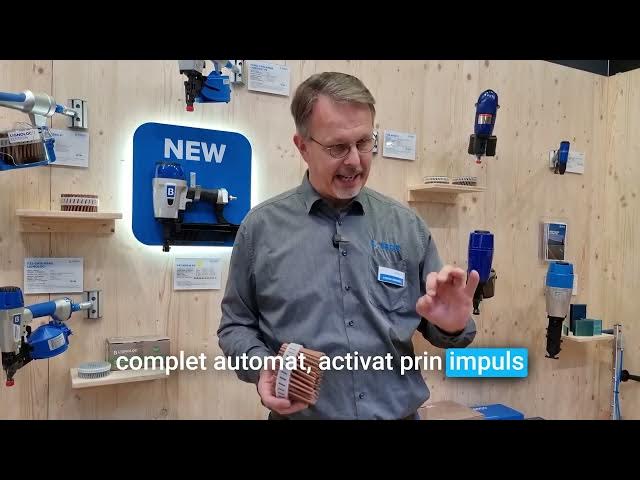
A head is a full automatic nailing gun
3:28
that is activated by electric impulse
3:30
and the shooting very very fast. This is
3:32
this nailing head. We have a big
3:34
quantity of nails in the magazine. When
3:36
we take the small ones, the 3.7 mm,
3:40
there are 850 nails inside. And when we
3:43
talk about the bigger ones, oh, it's
3:47
Unfortunately, this was a coil of the
3:49
bigger one. We have 400 nails on this
3:51
coil. You can see here are the
3:53
connectors, electric connectors for the
3:55
activation, for the sensors to run this
3:58
tool. We have some very interesting wall
4:01
samples here because many customers are
4:03
asking now, what are you doing with this
4:05
legal lock? It's a nail. Yes, it's only
4:06
a nail, but you can use this nail for
4:08
construction. This is a stud framing
4:10
wall example and the stud framing was
4:13
cladded with three layer panels
4:16
and these panels are nailed visibly with
4:19
vignal lock. It means if the house
4:22
builder has customers and these
4:24
customers love wood but they want to see
4:26
the wood in their house. You can do it
4:28
like this. You can show the nails
4:30
directly. You can show the fastening
4:32
pattern how it works. If you don't want
4:34
to see it, you can also use Gibson fiber
4:37
boards. This is all included into our
4:40
approval. Lalo nail has an approval for
4:44
static construction of wall elements for
4:47
stud framing. When we turn the wall
4:51
we can see another possible material.
4:56
also allowed to use as plywood and OSB.
5:00
We are allowed to use OSB for
5:02
construction. Here you can see this kind
5:05
of cladding. This is a typical jingle
5:08
design using in the Alp regions. Very
5:11
nice connected with the small legalog
5:13
nails with the very small ones. We can
5:16
see other examples. This for example
5:20
is NLT. This is board on board on board
5:23
all connected with nails. You can use
5:26
this as a ceiling flat or as a wall.
5:30
This is not in included into our
5:32
approval but we have customers that have
5:35
approvals for this. This is the company
5:36
Prima for example. Here you see another
5:39
example. This is a customer of us. The
5:41
company wood block. You turn around.
5:44
This is another hall. This is CLT but
5:47
without glue. They make CLT crosswise
5:50
orientated boards connected only with
5:53
nails. Only with nails. This is the
5:55
visible side. You see nothing. And when
5:58
we look take a look at the other side
6:00
you can see all the nails.
6:02
We need approximately 78 nails per
6:06
square meter to build this wall. The
6:08
benefit is this is easy. This is no
6:10
glue. You can cut everywhere. You have
6:13
all possibilities to work with this one.
6:16
This is a wall from a customer
6:20
Kim Holtz house. It's a very massive
6:22
construction you can see and they are
6:25
attached with nails. The last but not
6:28
least very good idea is our partner Neto
6:33
and what they doing they're making
6:37
it's like masonry you can use these
6:39
small bricks and build a house and all
6:41
these bricks are also nailed together
6:44
with econom brick is made out of six
6:48
piece of timber shooting together with
6:50
our econom and we are very proud that we
6:53
have these partners here in our booth
6:55
this is also very nice to See this is
6:58
something when we are never inside the
7:00
wood but when we make the cross-section
7:01
and cut through you can see the nail and
7:06
around the nail you can see this dark I
7:08
say corona and this corona is the heat
7:11
zone this is where the temperature
7:13
influences the lignine to stick together
7:16
somehow the dark corona is the mixture
7:19
of the compression because the nail you
7:21
don't have to pre-drill because many
7:22
people ask me do you have to pre-drill
7:24
no you can shoot directly into the
7:26
timber without pre-drilling. And because
7:28
of this compression of the surrounding
7:31
material and the heat influence, you can