












A wooden house factory provided as a service
The idea is simple, and that's why it's worth paying attention: instead of hauling materials to a wooden house factory, you send the factory to the construction site. You don't buy machinery, you don't hire CNC operators, you don't invest millions. You order production capacity - you pay per square meter of structural panel produced - and a robotic system makes your walls, floors and roof right where you build.
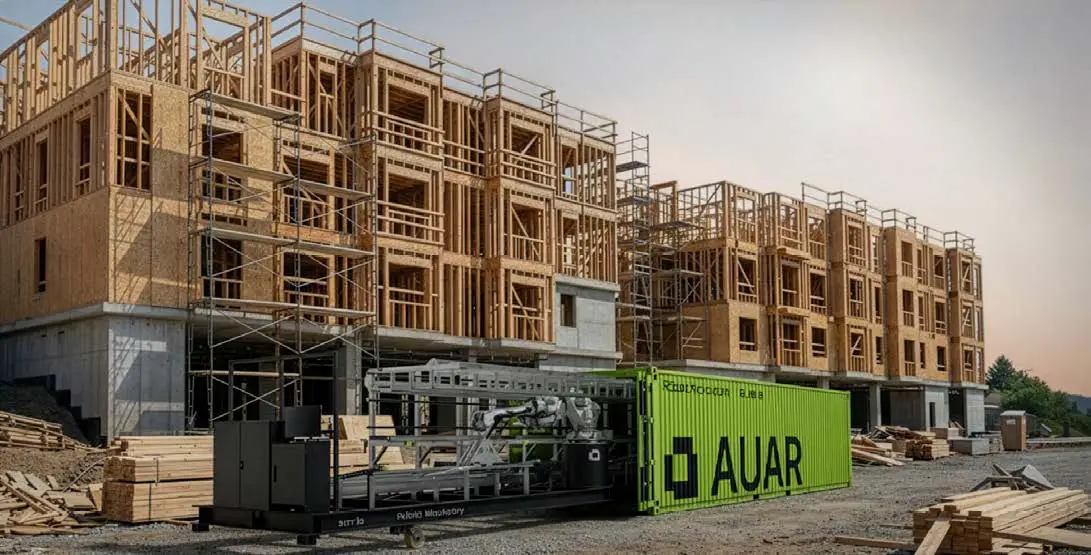
It does AUAR - Automated Architecture - a UK startup that has raised £7.7 million in funding, an industry partnership with ABB Robotics and CNN attention, also less than two years after the first commercial deployments.
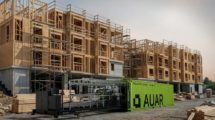
From British academia to Belgian construction sites
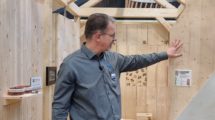
Mollie Claypool and Gilles Retsin are not classic building contractors. They spent a decade as professors at the UCL Bartlett School of Architecture in London, studying how robotics, generative design and structural timber can be combined. In 2019, they turned their research into a company.
The first years were development. Prototyping, testing, tweaking. But since 2024, things have accelerated: commercial projects in Belgium and the US, more than 300 homes to which AUAR technology has contributed, and a £5.1m round led by Planet A - a European climate tech fund. Company valuation: £26.1m.
In December 2025, they won the European finals of the ULI PropTech Innovation Challenge - the Urban Land Institute's competition for decarbonizing housing solutions. In March 2026, CNN dedicated a report to them. From the lab to international news, the journey was shorter than anyone in the industry expected.
What a builder actually gets
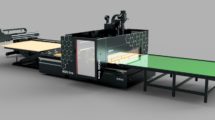
The system has two parts: a mobile robotic manufacturing unit - which AUAR calls MicroFactory - and an AI software called MasterBuilder.
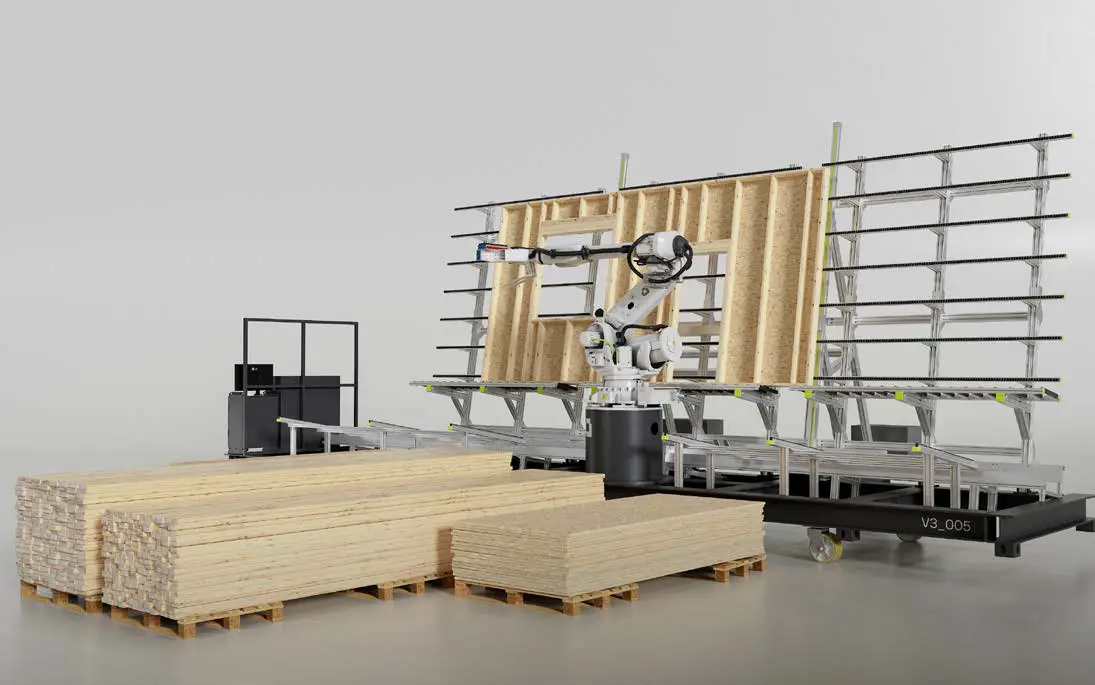
MasterBuilder turns architectural plans into manufacturing instructions. Import the design, the software generates cutting specifications, bill of materials, cost estimate and production schedule. All optimized for robotic execution without manual intervention between design and manufacturing.
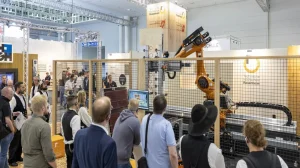
The production unit - compact enough to be transportable in a standard container - arrives on site or in a warehouse and is up and running in a matter of hours. An ABB robotic arm cuts, positions and assembles structural wood panels: wall frames with openings for windows and doors, ready-made channels for installations, fixing points. The field team receives bundles of panels ready for assembly - no additional cutting, no improvisation.
When one project is finished, the unit moves on to the next. The same equipment serves multiple sites, multiple builders, without any of them having invested in it.
Figures published by AUAR
The company communicates three main metrics. All deserve attention, but also a healthy filter of skepticism - these are the numbers of a scaling startup in need of visibility and investors.
8 hours for the structural panels of a typical house. A traditional timber house factory works in cycles of weeks. A crew of carpenters on site - days. If the figure holds up to scale, the time compression is significant.
20% cheaper than component manufacturers and traditional framing crews - with reductions of up to 30-40% on total cost in certain configurations, according to AUAR. The main sources of savings: elimination of downtime, reduced execution errors, independence from hard-to-find skilled labor.
Zero investment. The builder buys nothing. He pays per square meter of panel produced. It's an as-a-service model applied to manufacturing - like a subscription to production capacity. For a small or medium-sized builder, this removes the biggest barrier to entry into automated manufacturing.
ABB doesn't invest out of curiosity
Partnerships often say more than press releases. ABB Robotics is AUAR's partner on three levels: investor (through ABB Robotics Ventures), technology provider (the robotic arms and machine vision systems in the micro-factories are ABB) and research collaborator - together they are building ConstrucThor, a carbon-neutral research center that also functions as a full-scale demonstrator.
ABB's logic is transparent: every AUAR micro-fabrication sold means an ABB robot placed. But that doesn't diminish the signal - an industrial giant with more than a century of experience in automation has evaluated the technology and decided it's worth the investment, the engineers and the reputation. For anyone in the timber industry watching where the money goes in automation, this is a benchmark.
Optimistic forecasts and European reality
AUAR aims to have 1,000 active micro-factories by 2030, producing 200,000 homes a year, with revenues of over £1 billion. It currently operates about three units.
From 3 to 1,000 in four years. Even in tech, where rapid scaling is the cultural norm, the figure raises questions. In construction - an industry in which adoption cycles are measured in years and each market has its own structural standards, fire regulations and certification requirements - forecasting seems built more for investors than operational planning.
And that's understandable. A startup with a promising but early-stage technology needs continued capital for growth. Big numbers generate the necessary excitement in the market. But they are worth reading with discernment.
Each European market AUAR wants to enter - Benelux, DACH, Nordics - comes with its own challenges. A production facility operating in Belgium does not automatically produce compliant panels in Germany or Sweden. Adapting to each market requires not only technical investment, but also time for certifications, relations with local authorities, understanding the supply chain.
There is a place in the market. Monopoly - no.
What AUAR does well is that it validates a model: decentralized, robotic, service-provided manufacturing works in commercial-scale wood construction. That's valuable whether AUAR gets to 1,000 micro-factories or just 50.
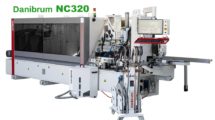
But they are not alone in tackling the problem. The timber construction market is growing all over Europe, and with it the interest in automation. Manufacturers of CNC woodworking machines - from Hundegger to Weinmann, from Randek to Essetre - are also developing increasingly affordable solutions, increasingly integrated with design software, increasingly in line with the idea of flexible manufacturing. Artificial intelligence is making design and optimization processes faster and cheaper for everyone, not just a London startup.
The democratization of wooden house production will not come from a single direction. It will come from the convergence of several trends: cheaper robots, smarter software, better-performing wood materials and a growing regulatory push towards low-carbon construction.
AUAR is an interesting player in a fast-moving landscape. It's worth watching - not as the only answer to the housing crisis, but as an indicator of where wooden home manufacturing is heading: more mobile, more flexible, more affordable. And if the current version of the micro-fab can fit in a container, it's reasonable to think that version 2.0 will be even more compact, once the model is validated at scale.










 Română
  Italiano
  English
  Deutsch
  Español
  Français
  Polski
  Português (AO90)
Add comment