


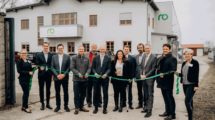





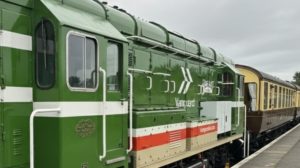
I have been visiting Italy for 23 years, as a tourist and on business, from North to South. If there's one thing I've learned in all these years, it's that Italy is not revealed from a screen. You have to be there, walk, take the train, drink espresso at a standing bar, miss an intersection and discover a market you can't find on Google Maps. That's why, on March 20, when the program at Essetre ended and the hosts offered to take us to the airport, we politely declined. We just asked them to drop us off at Thiene train station. From there we were on our own: a “Regionale” to Vicenza, another “veloce” to Verona, then a Flixbus to Orio al Serio airport in Bergamo.
It wasn't an adventure. We didn't get lost, we didn't miss anything. But the way back gave me, as always, a different kind of information - the kind that doesn't appear in any press release. At Vicenza station, for example, the line where your train is coming is on a printed planner, not an app. In a country where a German traveler accustomed to Deutsche Bahn would instinctively look for rerouting on their phone, here you come across a physical board. And it works. Italy has its own rhythm and if you don't accept it, you miss half of what it has to offer.
I say this because the same philosophy - in which tradition, human attention and direct relationships are not nostalgic but operating principles - can be found in Italian factories. Including Essetre.
Essetre: from a garage in Thiene to a partnership with Weinig
Essetre is the kind of company you don't really understand from a catalog or a website. Founded in 1979 by Giovanni Sella - literally in a garage, with a CNC pantograph - the company has today grown to over 9,000 square meters of production, more than 50 employees and a range of CNC machining centers covering the entire spectrum of timber construction: from timber frame wall elements to glulam beams, CLT panels and massive structures for airports or industrial halls. Some 90% of the company's current production is aimed at the timber construction sector - a strategic reorientation away from furniture and kitchens, the areas Essetre built its name on in its first decades of business.
A few years ago, the German Weinig Group - one of the world's largest manufacturers of woodworking machinery - became a shareholder in Essetre. Partnerships between the two companies are increasingly visible: at LIGNAthe DACH+HOLZ, At this Open House and other events, Essetre and Weinig appear together. It's a combination that works precisely because each side brings something different - the precision and structure of German engineering, the flexibility and creativity of Italian.
What makes Essetre special is not necessarily its size, but its flexibility. Each machine is custom designed, tailored to the customer's specific needs. They don't deliver from stock. And this is best seen when you walk into the factory and see, side by side, machines that look similar but have completely different configurations.
A factory tour led by Luca Viero
Essetre has no clearly demarcated sections with partitions and signs. It's a big hall where you understand what's going on in the positioning of machines, the flow of materials, what people are doing around each machine. It's a huge workshop rather than a factory in the classic sense of the word - and that says something about the way Italians work.
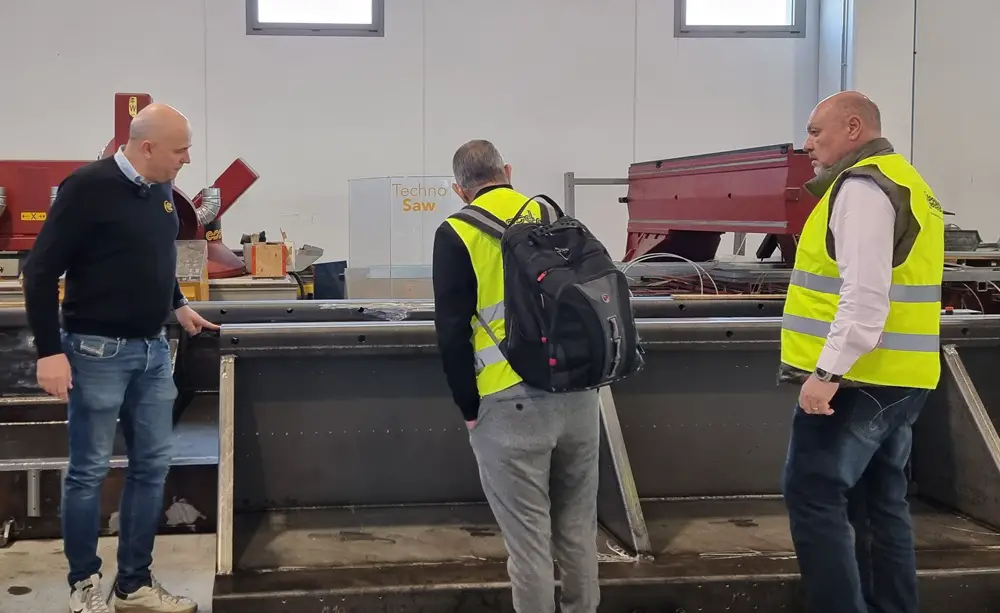
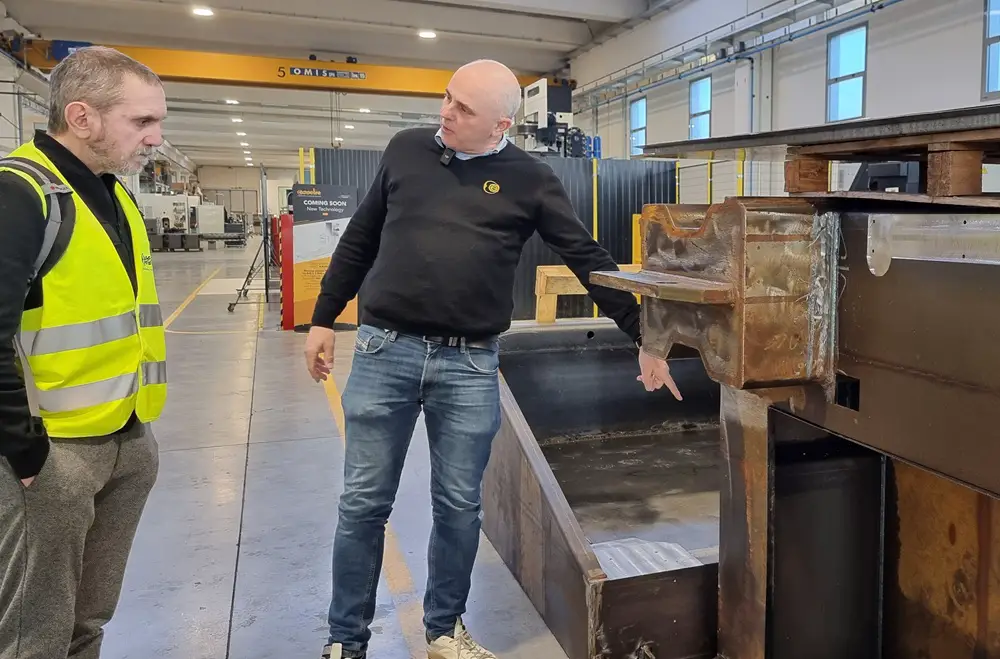
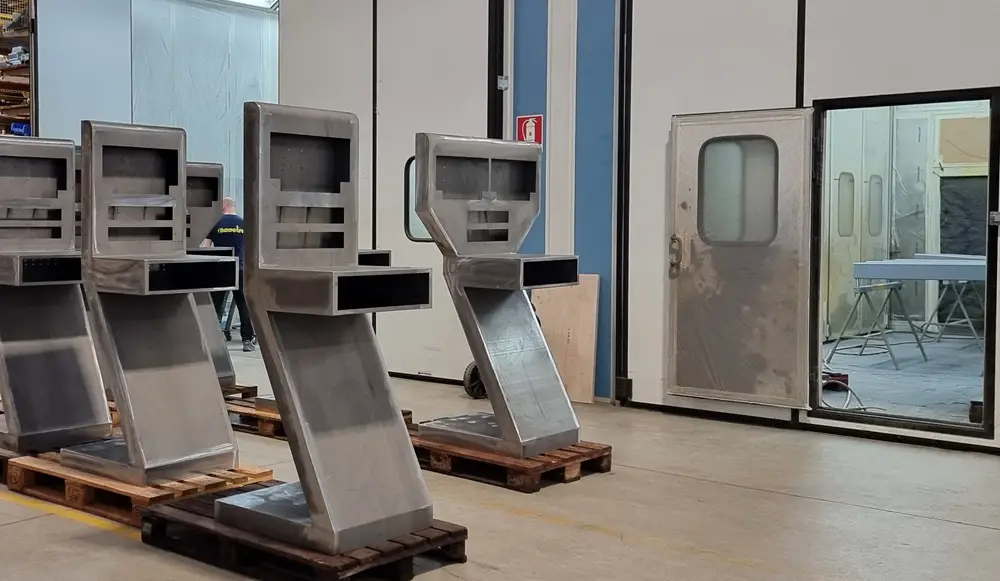
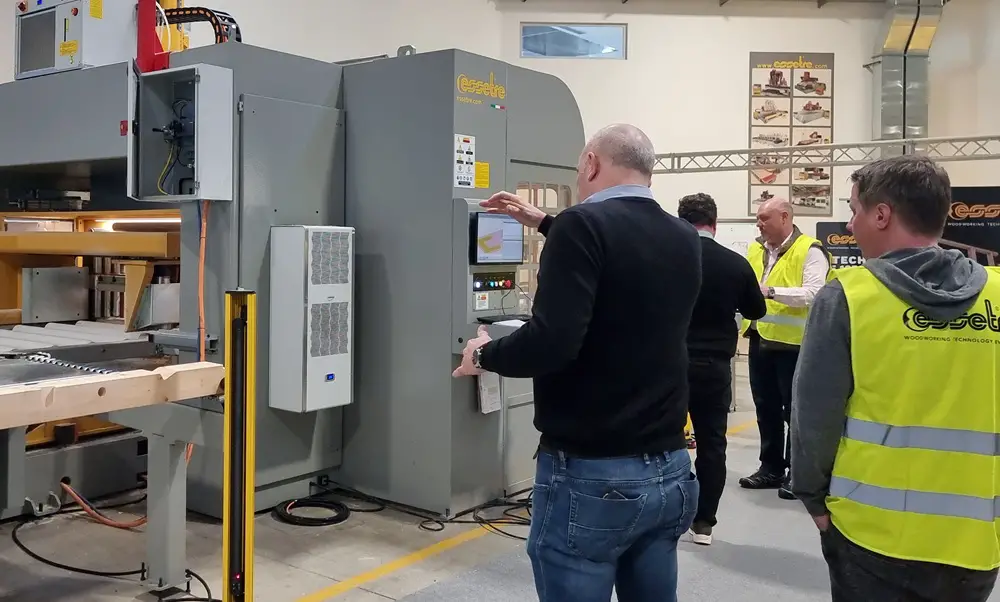
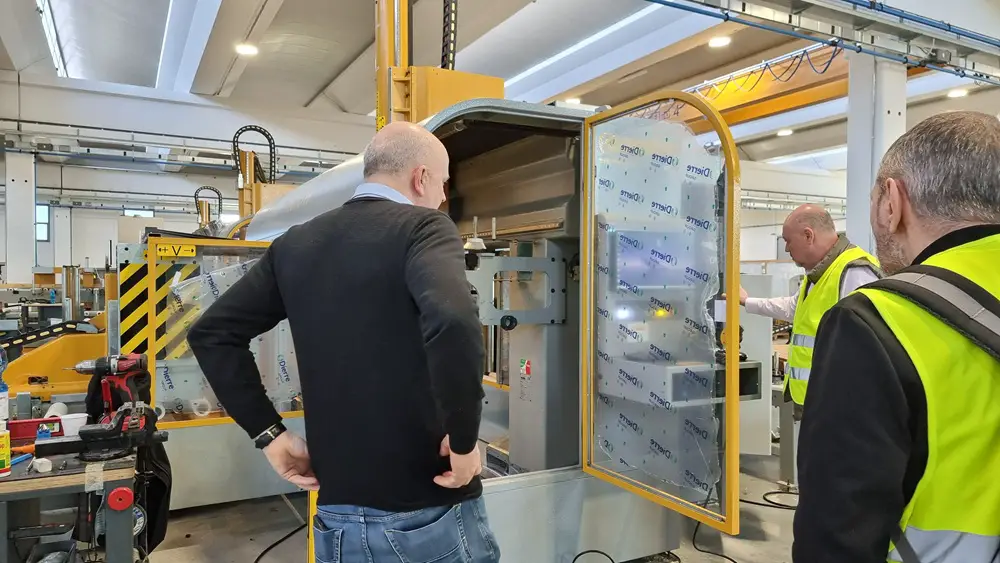
You'd think that walking into the halls of a five-axis CNC center manufacturer, the tour would start with the production line. With something spectacular, impressive to justify the trip to Thiene. Well, not at Essetre. Luca Viero, our host, started the tour in an area that few manufacturers proudly display: the reconditioning area. It is, in a way, a statement of principle. Essetre takes used machines from growing customers who want bigger or better equipment, completely replaces their basic parts, refurbishes their spindles and electromandrels (the integrated motors that directly drive the machining tools), repaints them and offers them with warranty. The message is clear: the customer relationship doesn't end on delivery. At the time of our visit, four to five reconditioned machines were ready, and one of them - a Techno One with a 400 x 800 mm work section, five spindles and tool magazine - was to be tested in the very next few days by a customer in France.
Also in the reconditioning area, we discovered something unexpected: large-scale machines for the production of kitchen countertops - machines that cut, automatically apply edge and finish panels in a continuous flow. The installations were impressive in scale, with the edgebanding strips stored vertically on huge rollers in a configuration of dimensions I had never seen before. It's a reminder of Essetre's origins - the company has long been a benchmark in furniture and kitchen machinery, and the refurbishment of these machines shows that the expertise hasn't been lost, even if the focus has shifted to construction.
From there we gradually moved into the actual production area, where things get really impressive. Essetre's machine frames arrive as welded metal structures, machined on Mazak CNC machines - Japanese, in line with Essetre's philosophy of using only top-notch precision equipment - to lengths of up to 14 meters, then mounted on a one-piece cast concrete base, which provides stability and vibration dampening. There are seven CNC centers for in-house production alone. After machining, the parts pass through a dry-cleaning unit, then two painting booths. After that, assembly begins. And this is where that typical Italian mix comes back: state-of-the-art CNC machines machining the components of state-of-the-art CNC machines - but assembled by people who know exactly what they're doing, step by step, component by component.
Techno Flex - the absolute novelty of Open House 2026
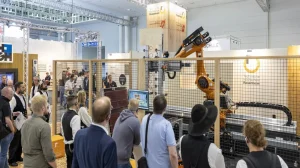
The star of the show was, without a doubt, Techno Flex - a new concept of a machine, presented for the first time. Similar in philosophy to the Multiwall, but built on a different principle: two independent rail blocks, one for the work table (with repositionable cross supports, fixed by a double braking system), the other for the movable axle. The configuration allows remarkable flexibility in positioning the workpiece, and the total length can reach about 20 meters.
What makes the machine really interesting is Essetre's patented solution: a single five-axis electro-axis mounted on a rotating arm that allows machining on both sides of the workpiece - covering a working width of about 3.5 meters. The basic configuration includes a cutting disk, a magazine with nine tool positions, a probe for determining the panel position and a chain saw unit. The machine can machine large CLT panels, curved beams and various other structural elements.
An important practical detail: Techno Flex does not require a special foundation (pit) in the floor, which significantly simplifies installation. The chip drain is integrated, and the configuration can be extended with various options as required.
Techno PF 1250 EVO - all-sided machining without turning the workpiece
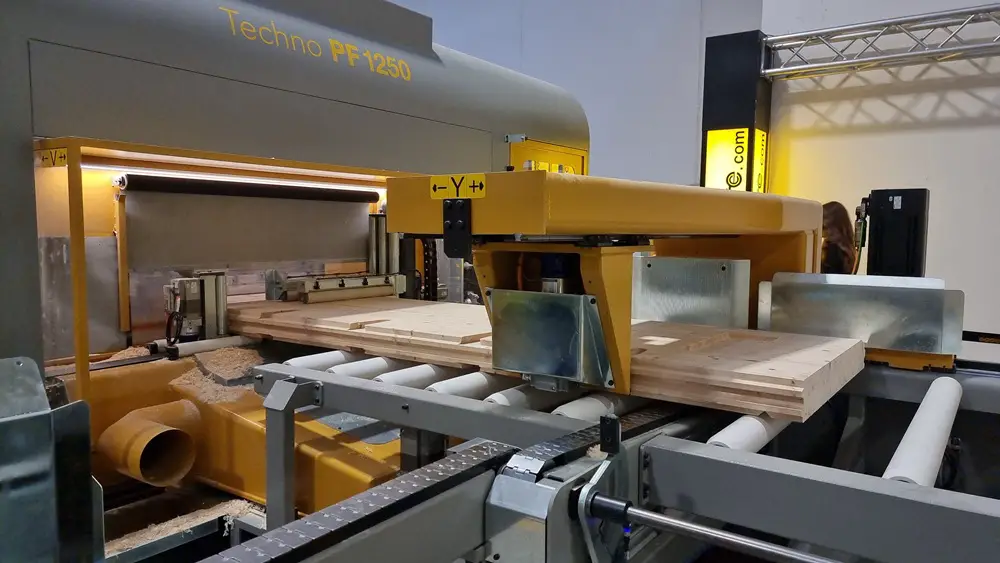
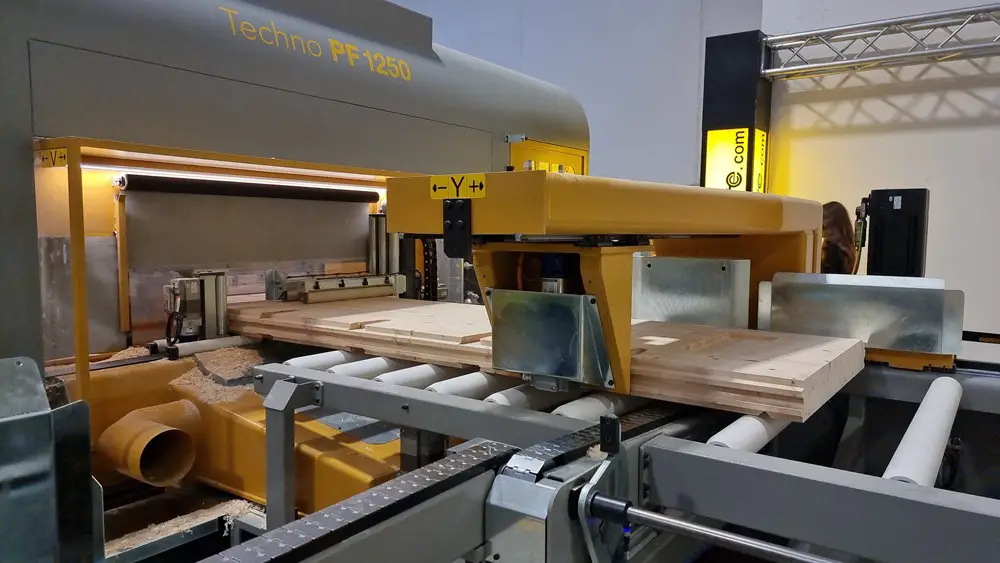
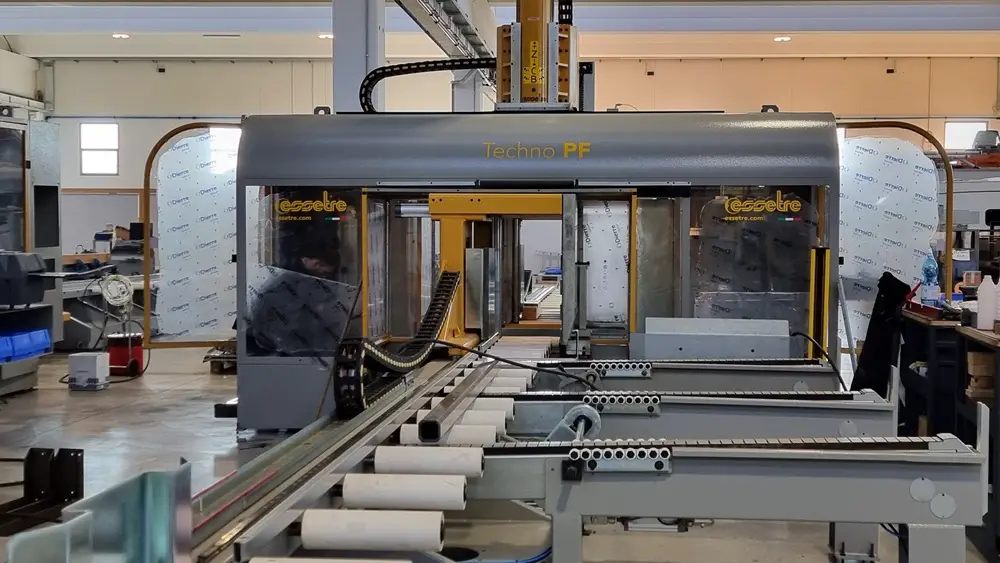
Techno PF 1250 EVO is Essetre's patented CNC machining center, designed for beams and panels with widths up to 1300 mm and modular lengths - from 13-14 meters in the typical configuration up to 24 meters on demand.
The central concept of the machine is the machining on all sides of the beam or panel without turning device, which saves time, space and costs. The work area inside the cab comprises two independent and opposed operating units - one upper, one lower - equipped with 5-axis milling heads in continuous interpolation and 12 kW at 7,000 rpm electrospindles. Essetre also produces variants with three working units, including a large top-mounted cutting disk. The clamping system uses two movable main clamps plus two intermediate clamps to stabilize long beams. The electrospindles are liquid-cooled and the transport rollers are made of plastic to protect the wood surface - an important detail especially for visible building elements.
Luca Viero mentioned customers who operate Essetre machines continuously, three shifts, from Monday morning to Saturday noon - including a customer in the United States with three Techno Fast centers running non-stop.
Techno Saw XS - cutting, milling and printing directly on wood
Techno Saw XS is, in the Essetre range, a compact cutting and machining center with a maximum working section of 305 x 120 mm, optimized for small cross-section elements - timber frame wall components, timber frame, packaging elements. Typical working length is 6 meters but can be extended.
The important novelty compared to the previous version: the integration of a milling module. The machine was originally designed with a cutting disk only (420 mm diameter), but market demand required the addition of a milling unit, even though limited space does not allow complex configurations. Luca Viero has been transparent on this point: those who need more sophisticated machining - swallowtails, for example - should switch to the classic Techno Saw or Techno Fast. Essetre prefers to keep each machine focused on what it does best, rather than overloading it with features.
The most interesting feature of this machine, in my opinion, is the integrated inkjet printer, capable of printing logos, identification codes, information about the position of the piece in the overall construction, directly onto the surface of the wood - on two sides, continuously. Two printing heads cover a 25 mm band, four heads up to 50 mm. Luca stressed that part identification is becoming increasingly important as European traceability rules evolve. And he's right - in a fast production line, confusion between parts can lead to significant losses of time and material.
Techno Fast - the company's workhorse
If Essetre had a best-seller, it would be Techno Fast. At the time of the visit, five Techno Fast machines were in various stages of production simultaneously - rare for a company that produces to order.
Techno Fast is a 5-axis CNC machining center designed for beam sizes up to 620 mm high and 250/300 mm wide - the beam stands vertically in the machine, machining on all six sides without turning. The length is configurable and the typical configuration is about 13.5 meters. Loading is done automatically on a motorized conveyor and two multi-function clamps manage the workpiece in the work area. Machining is carried out by a 5-axis head with dual motor output: one with HSK 63F connection for automatic tool change, the other with flange for cutting disk up to 600 mm diameter. The automatic magazine has 11 tool positions, five of which are supplied as a starter kit by Essetre.
The machine also includes a beam size verification system - designed to prevent operator error, such as inserting a 200 x 300 beam in the wrong position on Monday mornings - plus options for chain saw, 90° turner, inkjet or label printer, and differentiated discharge conveyors (scrap vs. small recoverable parts).
The guard is made of industrial polycarbonate, and the whole machine fits on an area of about 70 m² - which, for the capacity it offers, is remarkable.
Techno Frame - automating the assembly of timber frame walls
The last machine in the wood construction series we saw was the Techno Frame - a relatively new concept dedicated to assembling wall frames. The principle is simple and elegant: the operator works from inside the machine, places the main pieces left-right on two side units, and the reference system automatically determines the position of each following element. The operator inserts the workpiece, aligns it, confirms the position, the machine nails and moves forward. Step by step, the frame takes shape.
Techno Frame usually works in tandem with Techno Saw XS: the first machine creates the frame, the second machine mounts the panel (OSB, for example), calibrates it, cuts off the excess and fixes the panel to the frame. Together they form a compact and efficient line for the production of prefabricated walls.
La Paterno Daniel: a complex roof in less than two hours
A good Open House doesn't stop at the manufacturer's factory gates. As part of the event we also visited Paterno Daniel, an Essetre customer near Thiene, where we were able to see the machines in real working conditions - not in demonstration mode, but in actual production. The result was eloquent: the complete parts of a complex roof were made in just one hour and 37 minutes. It's the difference between seeing a machine in a showroom and seeing it integrated into a real production flow, operated by people who work with it every day. And it's perhaps the best selling point a machine manufacturer can offer: letting his customers do the talking for him.
Why Open Houses will matter more and more
I went to Essetre Open House and in 2023 and now in 2026. Each time I walked away with more useful information than most booths at the big fairs. Not because the fairs don't have value - they do, and enormously so - but because an Open House offers something a 200-square-foot booth at LIGNA can't: context. You see the cars in their natural environment, you see them alongside the cars they were built on, you talk to the people who designed them, not just the people who sell them.
And that brings me to a broader observation that I've been ruminating on for a while: open house events are going to multiply in the coming period. Not because it's fashionable, but for a much more fundamental reason. We live in an age where digital communication has become so ubiquitous that it has eroded its own effectiveness. Screens have connected us to everyone - and, paradoxically, to no one in particular. In a landscape saturated with messaging, newsletters, webinars and video calls, the physical encounter has once again become a weighty act.
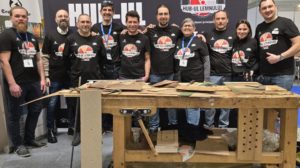
And it's not just happening in our industry. It's happening everywhere. The number of events involving physical presence will increase - especially those that bring together communities, people who share the same concerns or passions. The wood industry has no shortage of such people. In Thiene, during the two days of the Open House, we met producers of wooden houses from Romania, builders from Sweden, engineers who were discussing with Luca Viero swallowtails and sectional with the same enthusiasm with which others discuss football.
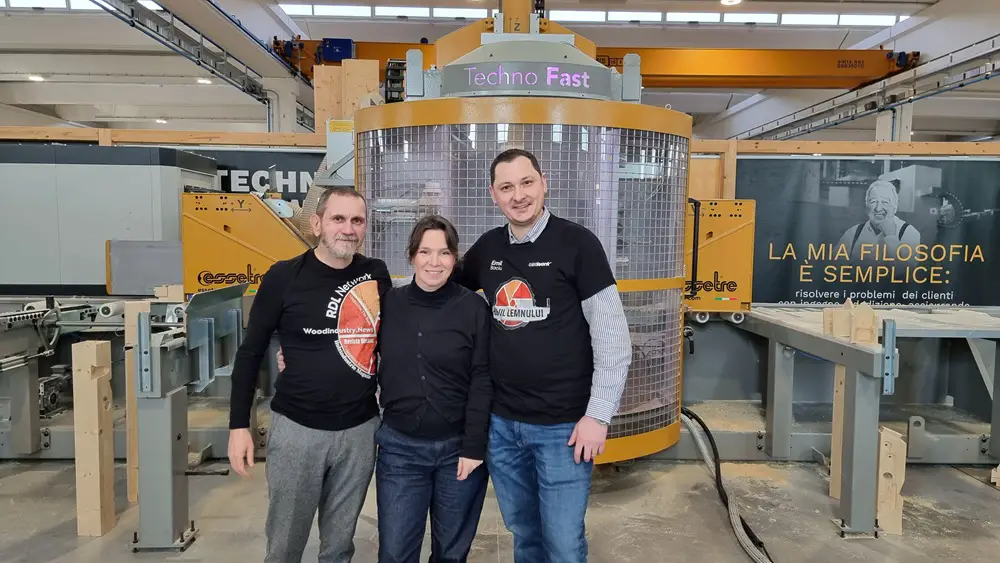
I came across Emil Baciu from cadwork Romania, member in Wood Hub, which evaluates Essetre solutions with the eye of a man who knows exactly what software will need to communicate with each machine. We spoke to Florin Dumitrașcu from Ligna Dumi Tech, who knows the Romanian market well enough to translate not just the language, but also the context: what car makes sense for a manufacturer who makes 50 houses a year and what car for one who wants to make 500.
The companies that find effective ways to create real, physical engagement with their partners and their audiences - not LinkedIn engagement, but handshake engagement and coffee sipped together next to a 20-ton car - will be the ones that win the most in the period ahead. Essetre has long understood that. And the fact that an Italian CNC machine manufacturer from Thiene manages to bring builders from Romania, Hungary, Sweden and the United States to its home says more than any marketing campaign.
After all, that's Italy: you can't understand it from the screen. You have to take the train from Thiene.
Article realized after visiting Essetre Open House 2026 (March 19-20, Thiene, Italy), at the invitation of Ligna Dumi Tech, Essetre's distributor in Romania.






 Română
  Italiano
  English
  Deutsch
  Español
  Français
  Polski
  Português (AO90)
Add comment