




Rotterdam is unlike other Dutch tourist cities such as Utrecht, Amsterdam, or Amersfoort. Rotterdam is a port city, with everything that comes with it: raw energy, a pragmatic attitude, and a sometimes harsh aesthetic, resulting from the massive reconstruction after the World War II bombings. It's a city that always looks forward, not back. An experimental city that isn't afraid to try new things.
Perhaps that's why SAWA fits so well here.
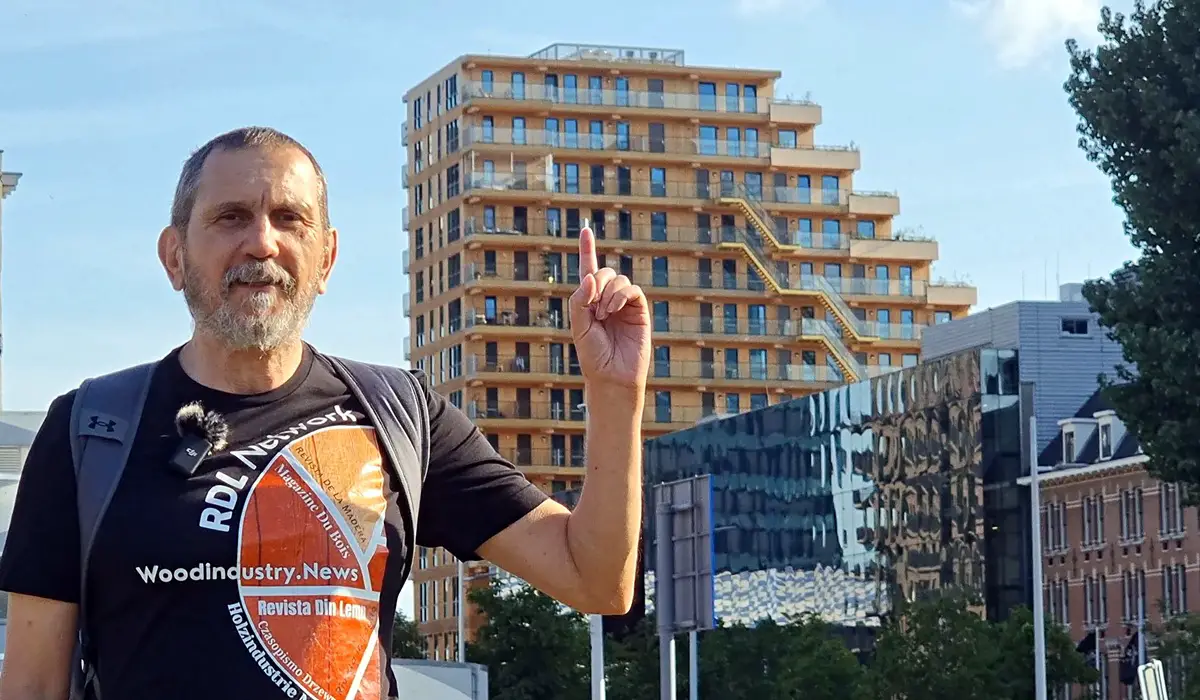
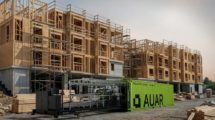
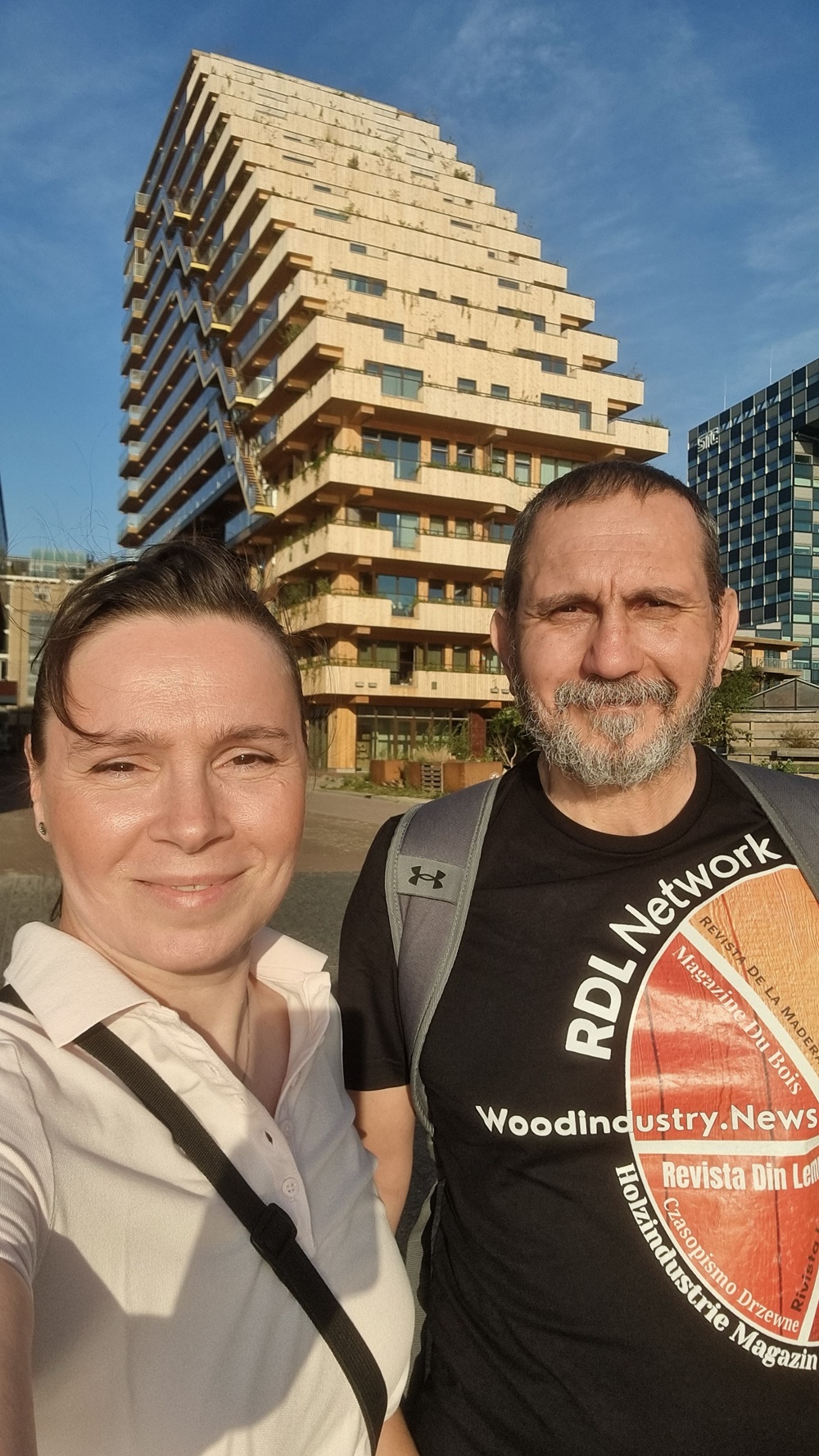
We get off the metro at Coolhaven. As we cross Lloydkwartier, a former port area transformed into a residential district, I spot it from afar: a terraced structure rising 50 meters above the canal. I feel somewhat emotional. I had seen it in models, I knew the dimensions, but observing this wooden construction that clearly stands out in the local architecture is, at least for me, impressive. SAWA is not just a building, but an architectural manifesto rising toward Rotterdam's sky.
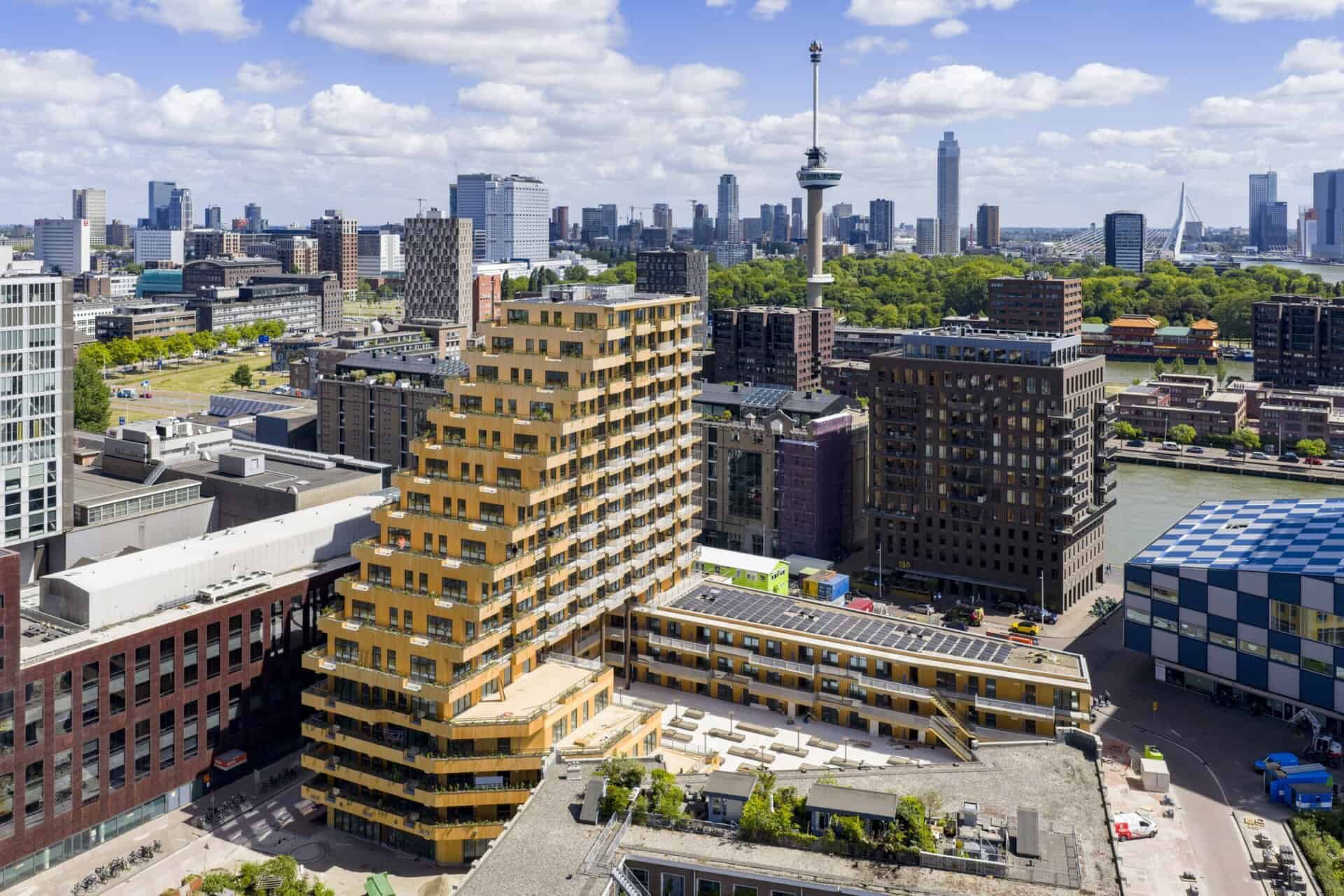
The building was recently handed over, with the first residents already moved into their wooden apartments. We're here to see how this project, which we've been reading a lot about lately, is looking finalized. SAWA's published materials, interviews and documentation have created considerable buzz in the world of sustainable architecture and construction, and now I can finally see the result for myself.
SAWA is Rotterdam's first high-rise residential building built predominantly of wood. But what does that mean in practice? With the exception of the foundation, basement and the central core (which houses the elevators and stairwell), the entire load-bearing structure is made of wood. Beams, columns, floors - all made of CLT and glulam.
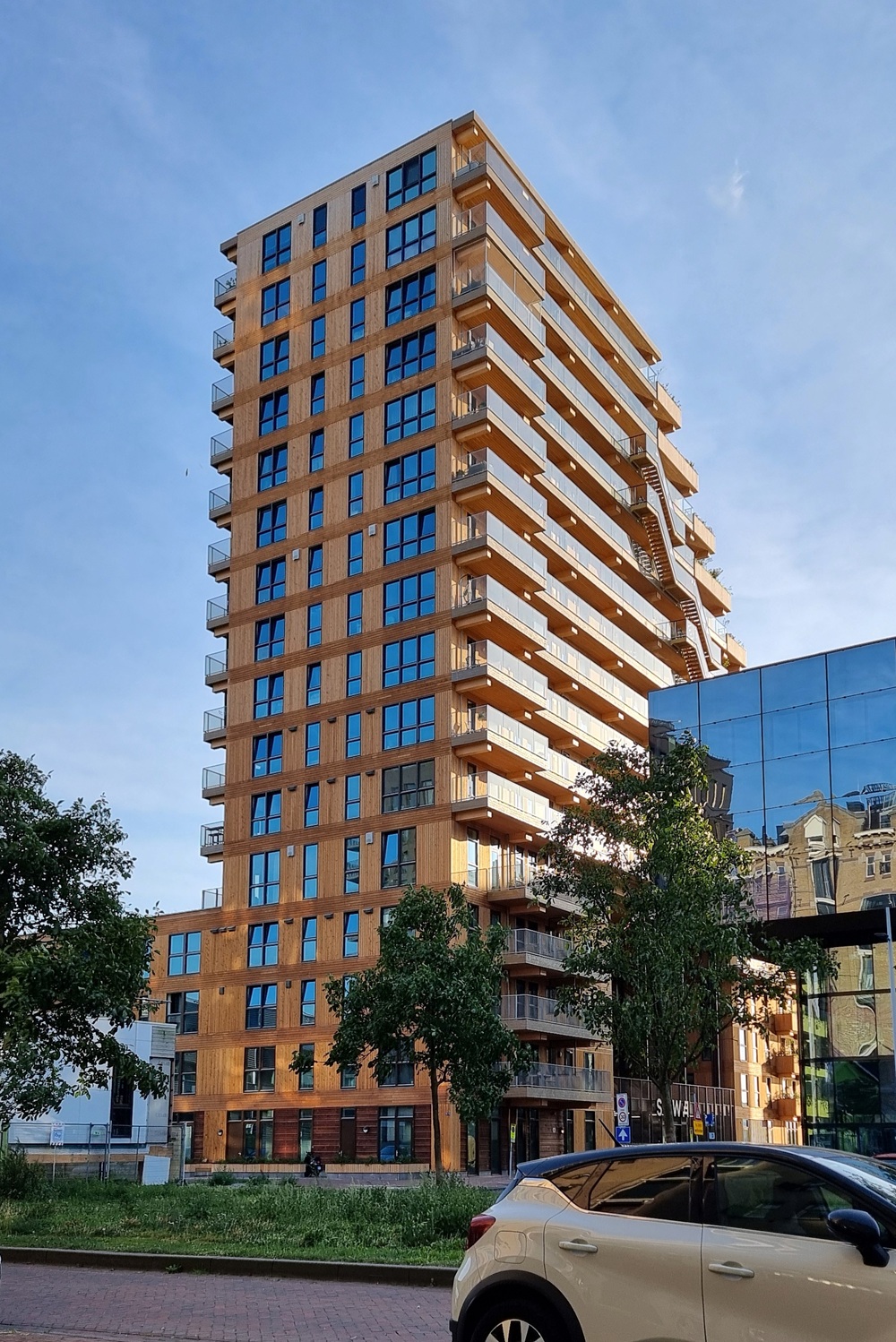
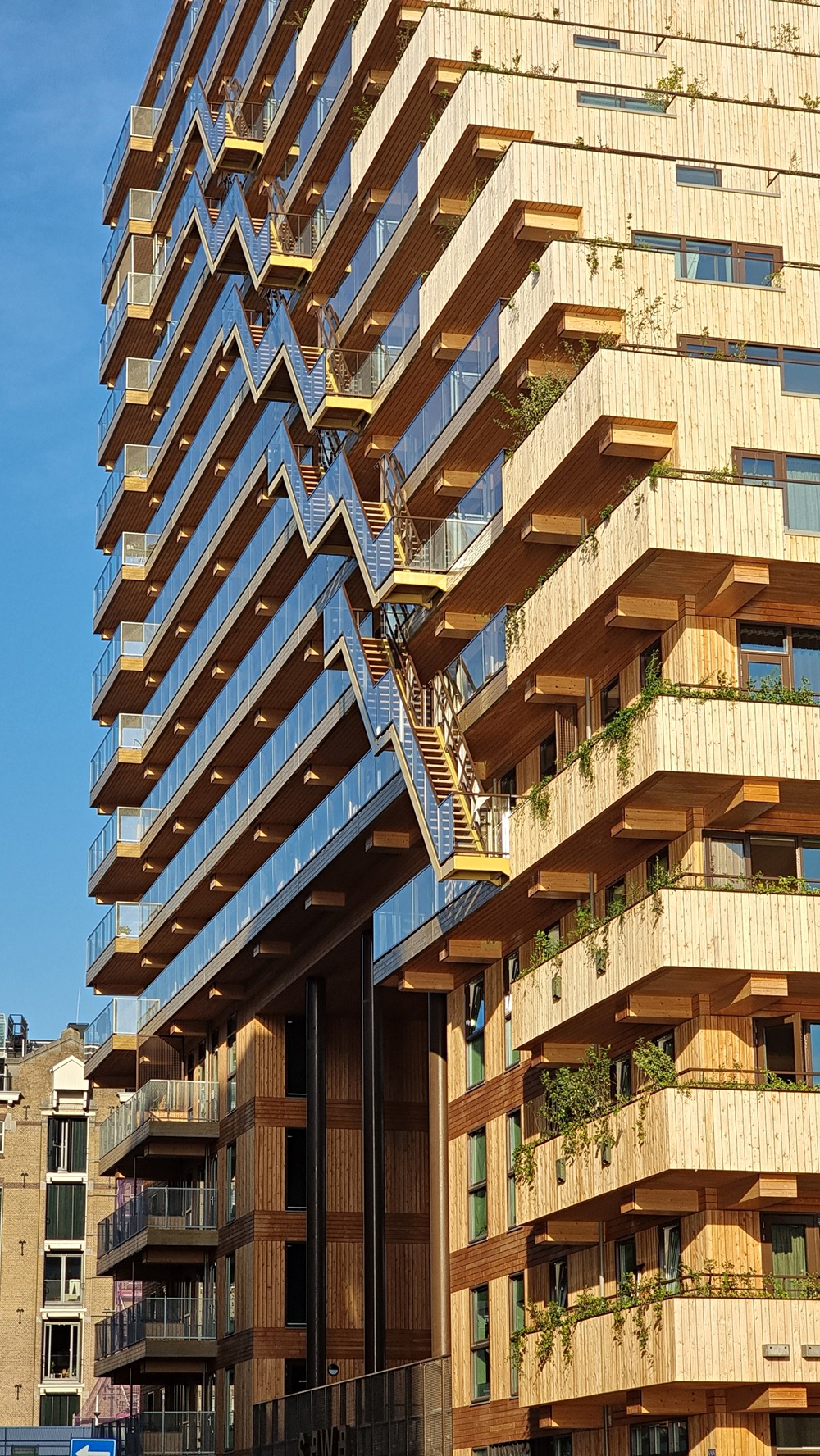
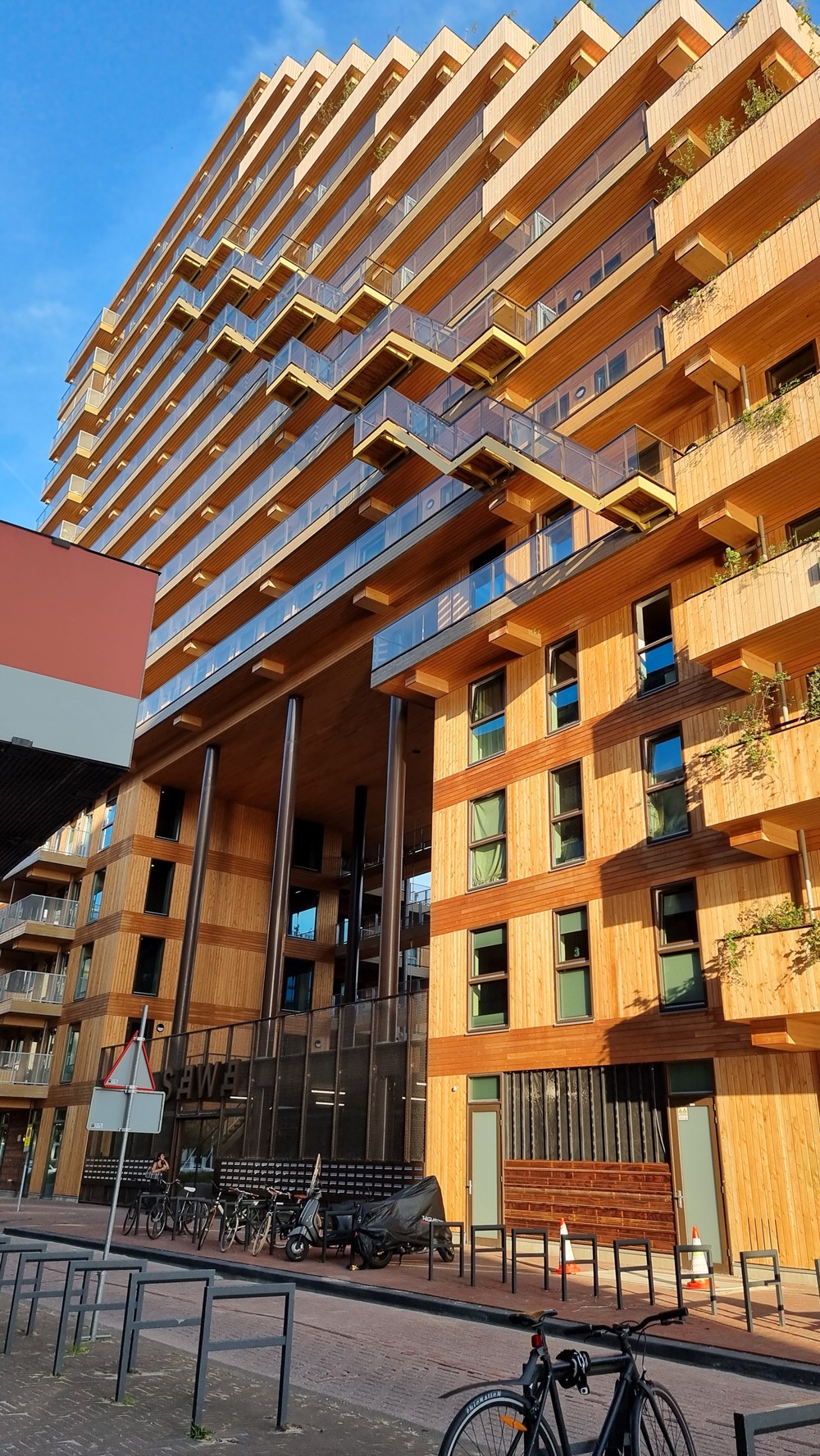
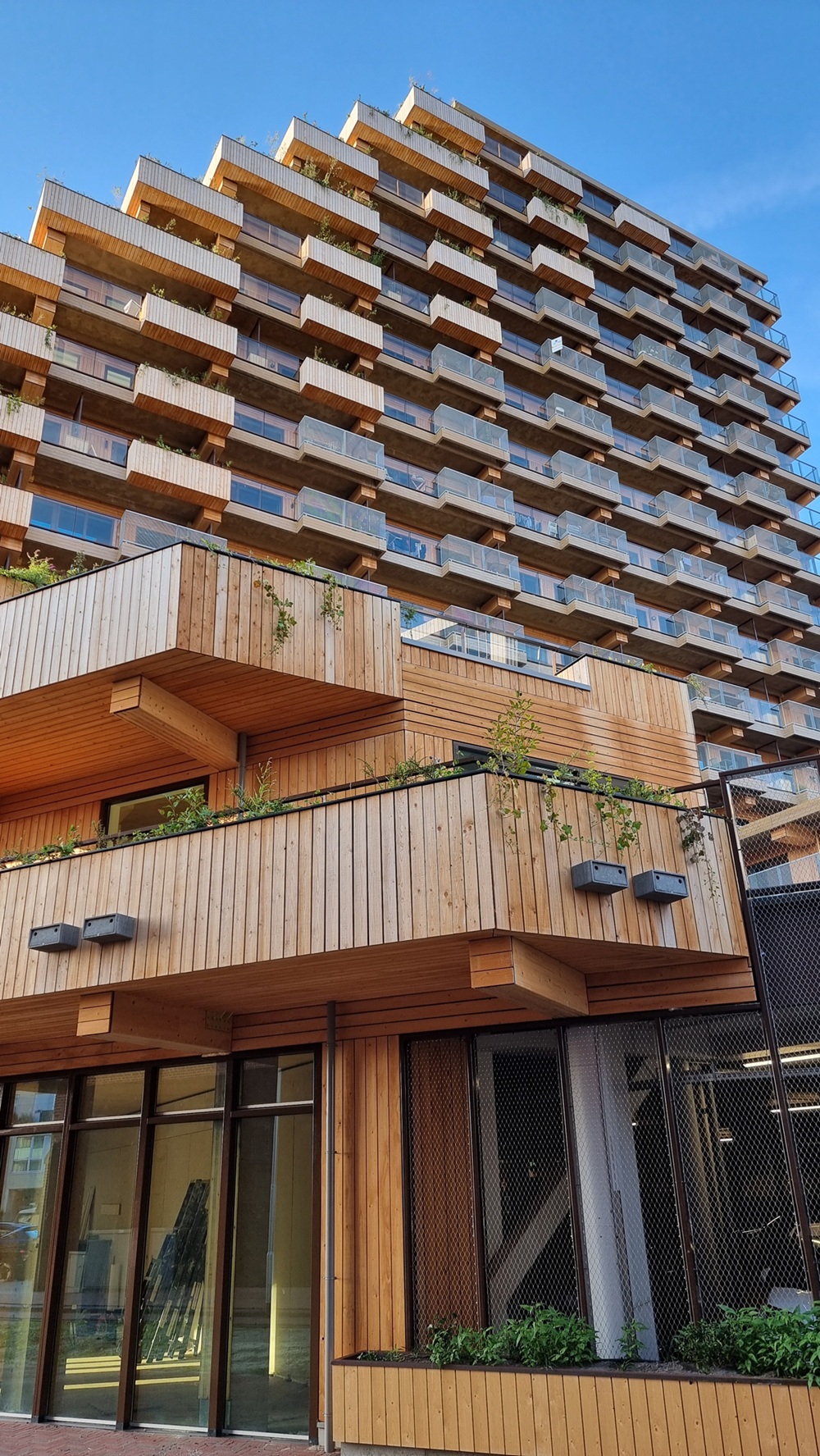
We approach the building and observe its details. Generous balconies create that characteristic stepped silhouette, and the vegetation that is already starting to grow confirms the much-talked about green approach. In the project documentation, Robert Winkel, one of the two initiators from Nice Developers, described SAWA as "completely innovative" and "unique in Europe". Moreover, he saw it as "the next iconic graphic design building in Rotterdam" that "matches buildings such as Markthal, Kunsthal and Fenix". Standing in front of her now, I can better understand the excitement behind those words.
Bianca Seekles, Director ERA Contour, , the second developer of the project, went even further in his vision: "As far as I am concerned, you will soon see pictures of the station, Markthal, cube boxes and SAWA on maps of Rotterdam." Looking now at the building in the context of the city, this prediction does not seem far-fetched at all.
The SAWA story began with a revelation. Mark Compeer, the other founder and developer at Nice Developers, tells the story of how the idea took shape after watching a documentary about timber construction and listening to a lecture on the subject. "I knew immediately: this is what we have to do. This is the future," he said in interviews during the project.
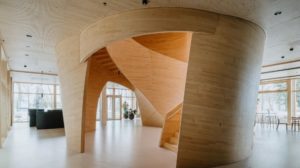
I'm struck by the warmth of the exposed wood. It's not just a visual sensation, but also a tactile and olfactory one - the building seems to breathe differently to conventional concrete buildings. The project's technical documentation details the innovative structural system: a network of laminated timber columns and beams spaced 6 x 6.90 meters, providing generous interior spaces without structural obstacles.
One of the major challenges of the project was managing the increasing loads at the lower levels. Rob Domen from Pieters BouwtechniekIn their technical documentation, the specialists in timber construction and those responsible for the structural work explain the ingenious solution adopted: instead of adapting the dimensions of the columns according to height, they adapted the quality of the wood according to the height. On the upper floors they used less dense wood, and on the lower floors, where the pressure is higher, they used wood of higher density and strength.
I can now see the result of these technical decisions - the visual coherence of the structure, despite the different engineering challenges from one level to another. The elegance of the solution lies precisely in its invisibility to the untrained eye.
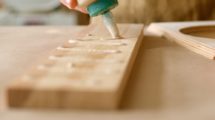
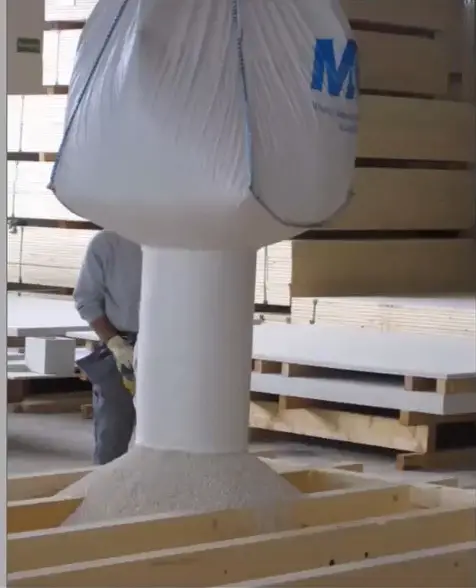
Flooring is another innovative element. Instead of the traditional concrete slab, SAWA uses a hollow wooden floor system: smaller beams the size of a floorboard, with CLT slabs above and below, and a layer of lime gravel in the middle for the mass required for sound insulation.
From the canal I can see the gardens taking shape. SAWA's green approach is mentioned by Piet Vollaard, the project ecologist. He describes the concept as 'building inclusive in nature'. These terraces and balconies are not just aesthetic elements, but part of a well-thought-out ecological strategy that creates a vertical habitat for various plant and animal species.
The contrast between SAWA and the neighborhood's former industrial landscape is obvious. Mark Compeer, who previously lived in the area, observes: "There is a lot of stone and very little greenery. It all looks very stark. It is, of course, still a former harbor area. But SAWA, with its wood, greenery and welcoming atmosphere, really adds something special."
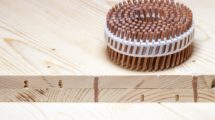
SAWA's construction process was as innovative as the end result. Wim Verschoor, site manager at ERA Contour, explains the ingenious prefabricated system used: the columns and beams were assembled in the factory as complete 'portals' for each floor, which were then lifted and assembled on site. This approach dramatically reduced construction time and minimized the need for complicated metal connections.
The wood used in SAWA comes, according to the documentation, from sustainably managed forests in North Rhine-Westphalia, West Germany. Derix Group, the manufacturer of the CLT elements, was responsible not only for manufacturing the components but also for assembling them on site. For every tree felled, four trees of different species were planted - a concrete commitment to sustainability.
But SAWA is not only an example of green building, it is also a social experiment. The 111 or so homes, 50 of which are for mid-rent, are designed to encourage a community lifestyle. Materials published by the project team talk about communal spaces, the rooftop garden parking lot and shared mobility services.
"Less to have, more to share," was Mark Compeer's philosophy for SAWA. This community aspect is visible in the design of the spaces, the layout of the apartments, and the prioritization of socializing areas.
The day is coming to an end and the sunset light colors the terraced wooden canal side of SAWA. I think about the impact this building will have on the future of urban construction. The project documentation talked about the flexibility of the construction, about apartments that can be combined or reorganized, walls that can be moved to adapt the spaces to the changing needs of the residents, to the needs of the next generation of residents.
Bianca Seekles, director of ERA Contour, said that "timber construction is still in its infancy, especially in the Netherlands," but that new building techniques have made it "more feasible and affordable."
As I look at SAWA in the golden light of the setting sun, I realize that I am looking not just at a building, but at a possible future for our cities. A future in which wood, humanity's traditional building material, returns to the forefront, enriched with modern technologies and a new understanding of our relationship with nature and community.
SAWA's distinctive silhouette looms over the Rotterdam skyline, a symbol of a new building reality, one that embraces sustainability, flexibility and community. And there is no better place for this revolution than Rotterdam, the city that is never afraid to look forward, experiment and reinvent what it means to live in a modern city.
We leave Lloydkwartier for Euromastthe nearby observation tower, with lots of raw video footage, with the desire to make a video about SAWA from it as soon as possible, and with the conviction that we saw not only a remarkable building, but also a model for the urban future that is beginning to take shape, floor by floor, beam by beam, from the wood that will define the cities of tomorrow. And if the founders' ambition is realized, SAWA will stand alongside Markthal and the Cube Houses as a symbol of Rotterdam's innovative spirit - a spirit that continues to redefine what a city can be in the 21st century.




 Română
  Italiano
  English
  Deutsch
  Español
  Français
  Polski
  Português (AO90)
Add comment