








The digital transformation of the wood industry is no longer a theoretical prospect but a concrete reality in modern workshops and factories. The increase in global demand for CNC systems reflects a structural change: the focus is shifting from pure mechanics to digital control and intelligent integration.
Performance starts with the control system
In the past, the main selection criteria for a CNC router were table size and cutter power. Today, the CNC controller and electronic architecture play a determining role.
An efficient control system ensures:
- Precise interpolation in complex contours;
- controlled acceleration without vibration;
- stability at high speeds;
- consistent repeatability in series production.
In the furniture and technical wood components industry, these elements directly influence the quality of joints, tolerances and final finish.
DANIBRUM ROD Line modularity: a CNC that evolves with your business
In a dynamic industrial environment where production requirements are changing rapidly, the choice of a CNC should not be a decision limited to current needs. Investing in a rigid piece of equipment without the possibility of expansion can become a brake on business growth. This is why the modularity of the ROD Line is a real strategic advantage for producers in the wood industry.
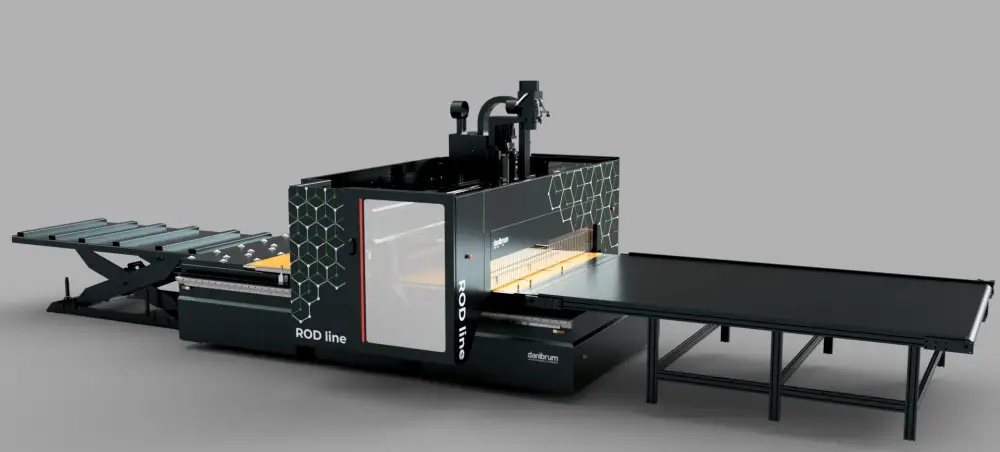
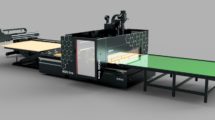
The ROD Line concept was not designed as a fixed machine, but as a scalable technology platform. The modular architecture allows the subsequent integration of additional options - drilling units, special aggregates, automatic loading/unloading systems, advanced optimization solutions or software upgrades - without having to replace the basic equipment. In practical terms, the CNC can grow with production volume, job complexity or product portfolio diversification.
For an expanding manufacturer, this is essential. In the first stage, the focus may be on standard nesting for chipboard or MDF. Later, as the business develops, the equipment can be configured for more complex applications, technical materials or integration into an automated line. Thus, The initial investment is protected and the amortization becomes more efficient.
Modularity also means technological adaptability. As new requirements arise - tighter tolerances, shorter cycle times, integration with ERP or digitized production systems - ROD Line can be upgraded to meet these standards without compromising mechanical stability or accuracy.
A CNC that evolves with your business provides financial predictability, operational flexibility and long-term competitive advantage. In an industry where the pace of change is accelerating, adaptability becomes as important as technical performance. And ROD Line is built on precisely this philosophy: industrial performance, backed by a future-ready modular platform.
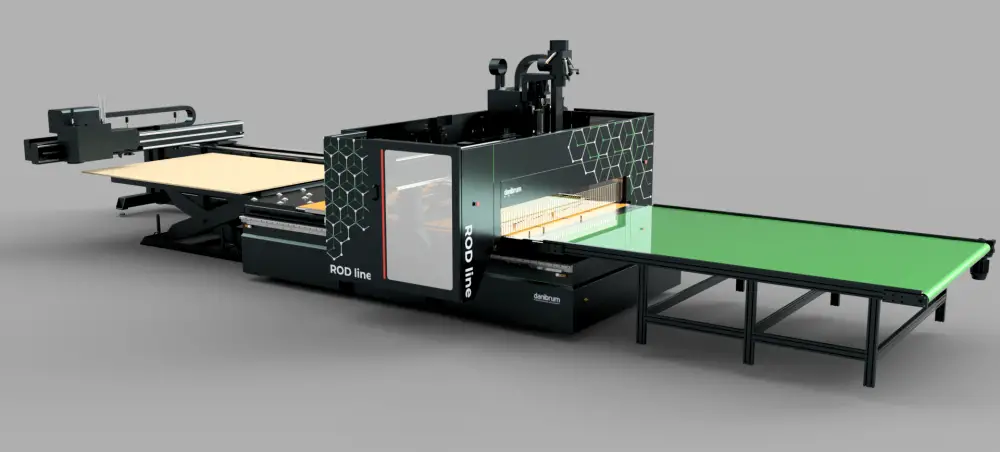
Integration of operations on a single platform
The current trend is the integration of several processes in one single machine: milling, drilling, cutting special shapes or machining technical materials. This approach reduces part handling, minimizes repositioning errors and increases productivity. For industrial manufacturers, eliminating intermediate operations can generate significant savings.
Rigidity and mechanical stability
Besides the digital part, the mechanical construction remains essential. Linear guides, gearboxes and drive systems must ensure load stability and repeatability in continuous operation. A CNC used in intensive production must maintain its accuracy not just in the first few months of operation, but in the long term.
Automation in response to staff shortages
A growing issue in the wood industry is the lack of skilled labor. CNC automation reduces reliance on manual operations and standardizes results. It allows operators to focus on programming and optimization, not repetitive execution.
Role of the technology provider
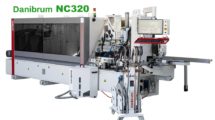
In this context, the choice of supplier becomes as important as the choice of machine. Experience in configuring equipment for specific applications and local technical support significantly influence long-term performance. DANIBRUM, active in the woodworking equipment market, is pursuing this direction by offering CNC solutions tailored to real production requirements, emphasizing integration, stability and operational efficiency.
The evolution of CNC systems is not just a technological trend, but a rethinking of the way the wood industry organizes its processes. And companies that adopt this transformation strategically will have a clear competitive advantage in the years to come.



 Română
  Italiano
  English
  Deutsch
  Español
  Français
  Polski
  Português (AO90)
Add comment