








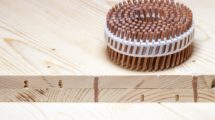




I've already written about how Lignoloc works. The compressed beechwood nail, the lignin welding, the 200 degrees Celsius that turns a split second into a permanent chemical bond - it's all there, explained in full. If you want the science, it's here: LIGNOLOC - Wooden nails that „weld” wooden elements without pre-treatment or adhesive.
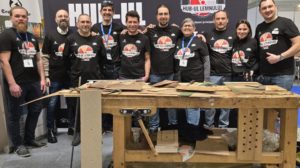
But DACH+HOLZ 2026, At the BECK Engineering stand in Cologne, it wasn't the nail that was the most interesting thing. It was what others did with it.
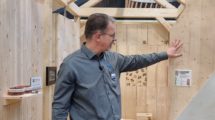
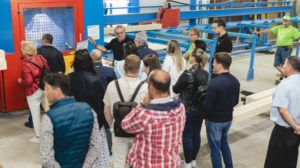
Stefan Siemers, R&D Director at BECK, guided us through a succession of wall samples that looked like a small museum of timber construction. Each sample came from a different partner. Each illustrated a different application. And each one said, in its own way, the same thing: a single fastener, with no metal and no glue, opened up a whole ramification of construction solutions that no one anticipated 12 years ago, when everyone was asking „A wooden nail? But what good is it?”
CLT without glue: 78 nails per square meter instead of glue
The most surprising sample on the stand belonged to Woodbloc. At first glance, it looked like a CLT panel (cross-laminated timber) ordinary - layers of wood oriented crosswise. Except there was no glue between the layers. Zero. Everything was held together exclusively with Lignoloc nails.
Stefan turned the panel and showed us the opposite side: 78 nails per square meter, arranged in a regular pattern. The visible side showed nothing. On the technical side, every nail was visible, every point of attachment marked by that dark „crown” - the thermal zone where the lignin had activated and created the bond.
Why does it matter? For at least two reasons.
The first is recyclability. It is the adhesive in conventional CLT that makes the panel hard to recycle. Wood glued with synthetic resins can no longer be separated into individual layers without being destroyed. A CLT held only with wooden nails, on the other hand, can be cut anywhere, separated, reused. It's a circular economy argument that the CLT industry hasn't had before.
The second is breathability. Wood is hygroscopic - it absorbs and releases moisture, naturally balancing the indoor climate of a home. In a conventional CLT, the adhesive films between the layers act as barriers: they significantly reduce the vapor permeability of the panel and thus the wall's ability to regulate the humidity in the room. A CLT without adhesive maintains the continuity of the material - water vapor can migrate freely through the entire section of the panel. It's a difference you don't see, but you feel it in the house you live in.
And both arguments come not from a research lab, but from a company that already produces and delivers.
Wooden bricks, stacked like masonry
If Woodbloc provided the technical argument, partner Nito provided the image that sticks in the mind.
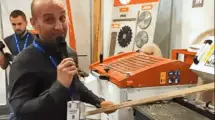
Their concept: wooden bricks. Six pieces of lumber beaten together with Lignoloc nails, forming a compact block. These blocks are then stacked just like in a classic masonry - row upon row, with staggered joints. The result is a massive wooden wall, built with a logic that every mason instinctively understands.
It's not a laboratory prototype. It's a building system that works, showcased on the BECK stand alongside the other applications. And it's perhaps the most accessible demonstration of what a wooden nail can do: turn raw lumber into a masonry element, without mortar, without glue, without metal.
Solid walls and NLT: carpentry reinvented
Two other samples completed the picture. One came from Chiemgauer Holzhaus - a German manufacturer of solid wood houses. Their wall, visibly thick and solid, was fastened entirely with Lignoloc nails. Massive construction, no compromises, no metal to create thermal bridges.
The other sample was NLT (nail-laminated timber) - plank over plank, connected with Lignoloc nails, usable as ceiling or wall. This application came through the Prema company and, although not part of the official BECK approval, is covered by the manufacturer's own approvals.
The difference between the two is significant: one is traditional solid construction reinterpreted, the other is a new engineered product. But both demonstrate that Lignoloc is no longer a single product for a single application - it's a platform.
Automation: from pneumatic gun to production line
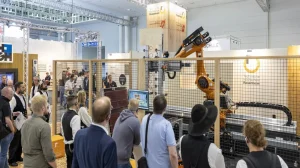
A nail is a nail as long as a man with a gun in his hand beats it. But when you step onto a prefabricated house production line - a Weinmann bridge, for example - you need something else.
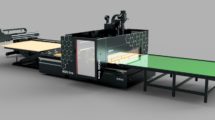
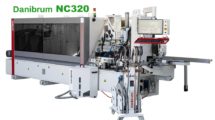
BECK has developed automatic, electrically powered nail heads capable of firing hundreds of nails per minute. The magazines of these automatic heads hold 850 nails with a diameter of 3.7 millimeters or 400 larger nails on spools. Electrical connectors, sensors, impulse activation - everything is designed for direct integration into automated wall element production lines.
That completely changes the economic equation. We're no longer talking about a carpenter who chooses a wooden nail because it's environmentally friendly. We are talking about a prefabricated house manufacturer who chooses Lignoloc because it allows full automation, no metal in the wall, no thermal bridges, no problems with future recycling of components. It's an industrial decision, not a sentimental one.
An ecosystem, not a product
BECK Engineering invented Lignoloc in 2014. It's been 12 years. And what was a curiosity - „a wooden nail, but what good is it?” - has become an approved construction platform for static timber-framed wall construction, compatible with tristrat panels, MDF, tackle, OSB and plasterboard.
But the real story at DACH+HOLZ 2026 wasn't about the nail specs. It was about what happens when an innovation gets into the hands of the people who actually build. Woodbloc took the glue out of CLT. Nito reinvented brick. Chiemgauer Holzhaus builds massive walls without any metal elements. Prema produces NLT ceilings with a fastening system that a decade ago no one thought possible.
12 years ago, Stefan Siemers heard the same question every time: „A wooden nail - but what good is it?” Today, the answer no longer comes from him. It comes from those who build with Lignoloc.
Wood replaces steel. With every nail.










 Română
  Italiano
  English
  Deutsch
  Español
  Français
  Polski
  Português (AO90)
Add comment