




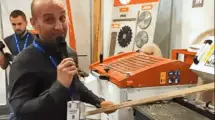









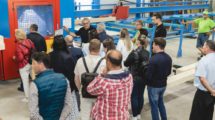




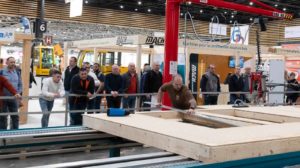
At Ligna 2025, Manfred Mueller from Universal Formers showed us their car Vacuum Former Standard Fold - a machine that seems to turn the complexities of vacuum lamination into a surprisingly simple process. As we watch the demonstration, we realize that this machine brings a fresh approach to processing composite materials for furniture.
"You put the adhesive between the layers. You put everything in the press, push it in, close the machine and apply pressure," Manfred explains during the demonstration. The simplicity of the process is striking - it doesn't seem at all complicated for someone who has never worked with vacuum forming.
Design that makes the difference
The first feature that draws attention to Vacuum Former Standard Fold is the flexibility of positioning. The machine can fully rotate, allowing the operator to work in the most comfortable position. "You can rotate it completely so that you have the work surface in the desired position. Then you fix it in place," Manfred shows us this seemingly trivial feature that makes all the difference in everyday work.
The operating system is deliberately simple: just a vacuum valve and a pressing table. The compact laminate work surface has built-in air exhaust ducts, and pressure control is via a common but effective panel.
Practical applications in the furniture industry
What impressed us most was the range of applications this machine can cover. Manfred explained that it is perfectly suited for:
Curved rolling:
- Multiple layers of wood with adhesive
- Upper and lower Furnir
- Complex shapes with radii from 2 to 10 mm
Flat pressing:
- All-sided veneer coating
- Application HPL (High Pressure Laminate)
- Cross-veneering works
Finished products:
- Kitchen furniture fronts
- Elements for bathroom furniture
- Components for residential furniture
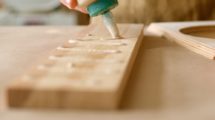
"With this shape you can do curved lamination, all kinds of shapes," says Manfred, showing us a finished piece demonstrating the quality achieved.
Convincing simplicity
The interesting thing about this car is that you don't need complex preparations. "You don't add anything here. It's just a polished edge," Manfred points out, referring to the fact that the parts come out of the machine virtually finished, needing only fine sanding around the edges.
For small beams - between 2 and 10 mm - the machine handles the job without a problem. Even for narrow strips, the process works just as well. Material flexibility is another quality: from classic veneers to modern HPLs, Universal Formers seems to have thought of everything for the diversity of market requirements.
The technology behind simplicity
Although it seems basic at first glance, Vacuum Former Standard Fold uses precise physical principles. The exhaust channels in the work surface are strategically positioned for even vacuum distribution. The system can maintain constant pressure even after the process is complete, allowing drying in place.
The machine can be "flipped" after completion, maintaining vacuum and allowing parts to dry in the optimal position. It's a technical detail that shows the engineers have thought about the actual workflow on the shop floor.
Distribution in Romania: 24Wood
One aspect that caught our attention is the fact that Universal Formers works in Romania with 24Woodthrough Katharina Seiler. "Our distributor in Romania is Katharina Seiler from 24Wood, and we have been working with her for a long time. It's a very fruitful relationship," Manfred tells us.
24Wood, a German-Romanian company founded in 2007, seems to be the right partner for such technologies - a combination of German reliability and an understanding of the Romanian market.
What I've learned
True simplicity of process and versatility of applications. It's not a machine that impresses you with complexity, but with efficiency.
For a shop thinking of diversifying services or for a manufacturer wanting to bring the vacuum laminating process in-house, this machine seems to offer a reasonable entry point. It does not require huge investments in training or special infrastructure.
Manfred has demonstrated that the equipment can produce professional quality parts without the need for a team of specialists. For the Romanian furniture industry, which seeks a balance between quality and affordability, it could be just the right solution.










 Română
  Italiano
  English
  Deutsch
  Español
  Français
  Polski
  Português (AO90)
Add comment